
Packaging design
Box dimensions and order-level packing were evaluated together, allowing the packing result to guide the next candidate set of box sizes.
- Industry
- Logistics / Packing
- Decision family
- Spatial planning
- Evaluation scope
- PoC test-data evaluation
Customer identity and identifying operational details are withheld.
The operating decision
A box-size set must reduce empty space while still allowing the items in every evaluated order to be packed.
- Inputs
- Item types and quantities per order · Item dimensions · Candidate box dimensions
- Decision
- Set of box sizes · Box selected per order · Item orientation and 3D placement
- Constraints
- Rotation rules · No overlap · Box boundaries · Packability of each evaluated order
How it is approached
Check packing order by order
Place and rotate the actual order items, then check overlap and box boundaries rather than relying on total volume alone.
Select among packable boxes
Try each order in candidate boxes and choose a suitable size among the candidates that can accommodate it.
Feed packing results back into size design
Aggregate fill and packability results, propose a new box-size set and repeat the evaluation.
Box-size search informed by order-level packing.
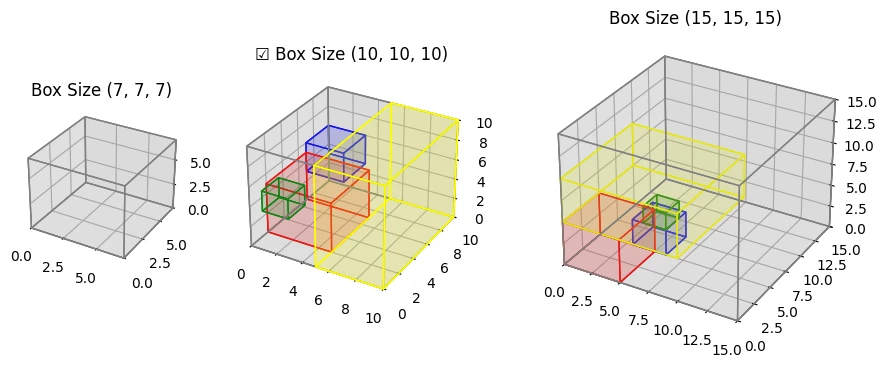
PoC test-data evaluation
Validation & scope
The source reports a PoC comparison on test orders. Its working examples show the method; calculation-time comparisons come from a separate final review. The evaluation supports box-size selection and does not establish operating-cost savings.
Related decisions
All applications
Bring the decision, its data and its constraints.