
Item ordering policy
Sales and stock histories were used to profile item turnover and compare order quantities and timing with existing ordering.
- Industry
- Retail / Packaged goods
- Decision family
- Inventory control
- Evaluation scope
- Historical-order simulation
Customer identity and identifying operational details are withheld.
The operating decision
A common stock rule can hold too much of slow-moving products while failing to account for the sales patterns of individual items.
- Inputs
- Sales history · Stock history · Item sales contribution · Turnover · Demand forecasts · Ordering rules
- Decision
- Target stock level per item · Order quantity · Order timing
- Constraints
- Item demand characteristics · Ordering rules · Stock reduction versus lost-sales trade-off
How it is approached
Read sales and stock together
Compare how much each item sells with how long its stock remains on hand.
Profile the item
Use sales contribution and turnover to redesign the stock level rather than applying the same level across the assortment.
Propose and replay ordering changes
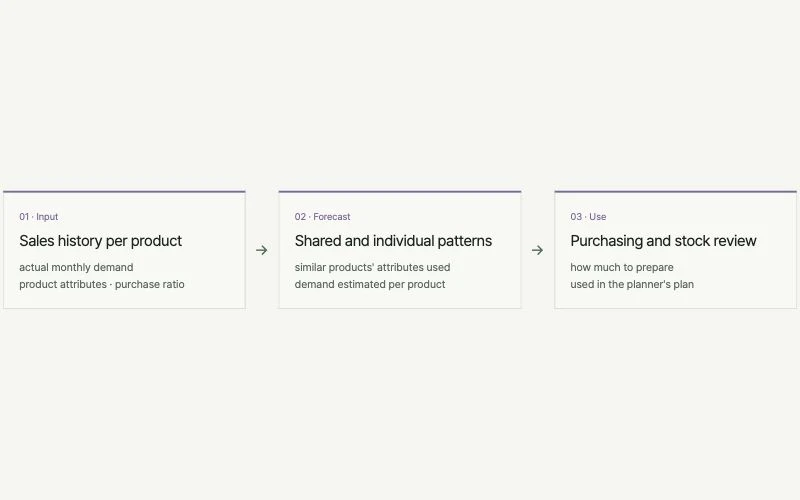
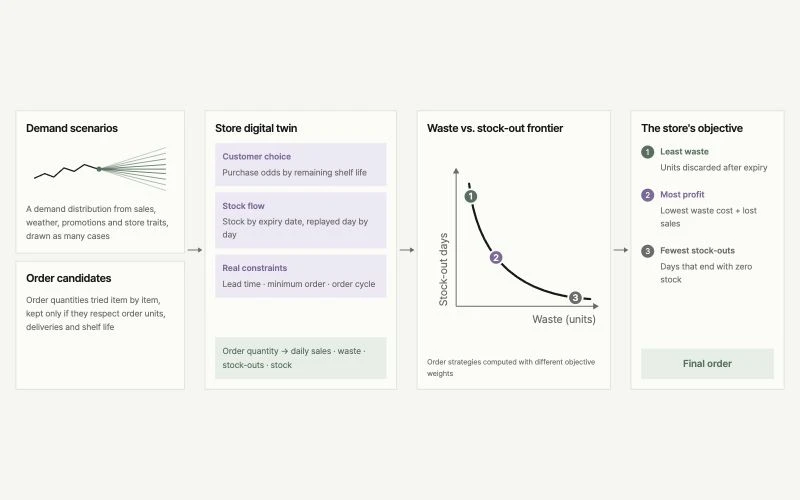
Combine the item profile, demand forecast and ordering rules to propose timing and quantity, then evaluate stock indicators alongside sales changes.
The decision structure
Historical-order simulation
Validation & scope
The source is a pre-PoC simulation against existing ordering using historical store data for one product category. Stock cost is a holding indicator rather than a realized saving, and the stock and sales changes must be interpreted together.
Related decisions
All applications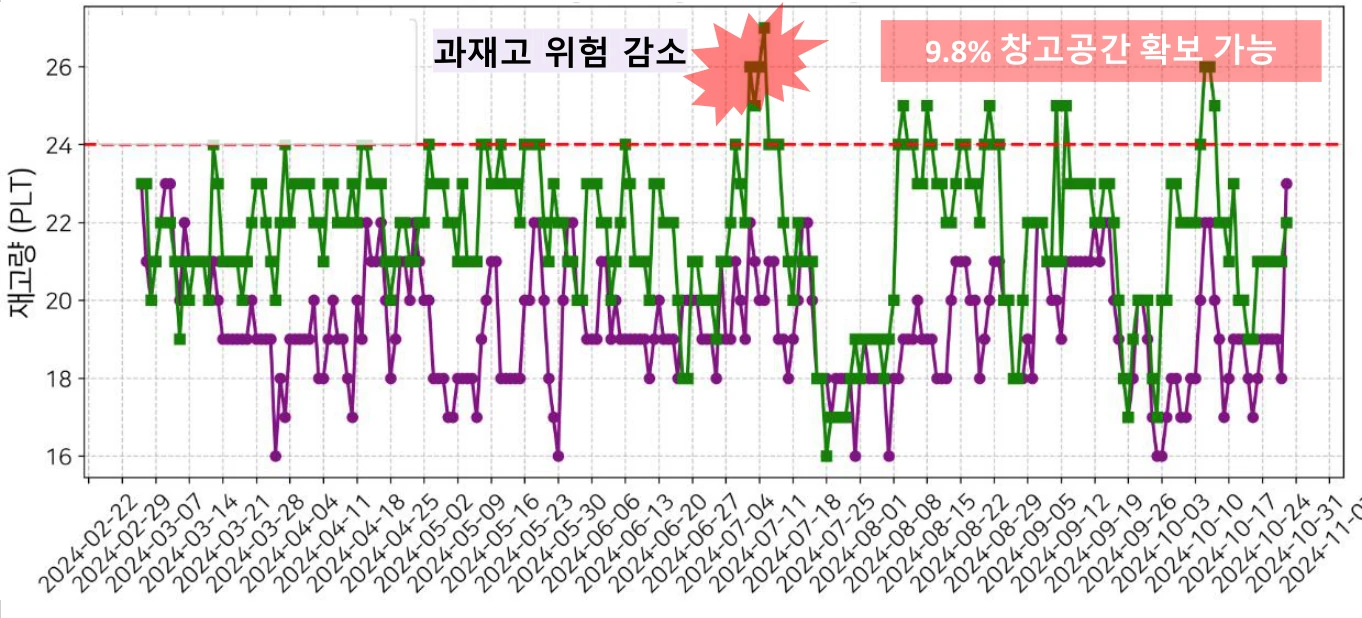
Bring the decision, its data and its constraints.