
Food inventory control
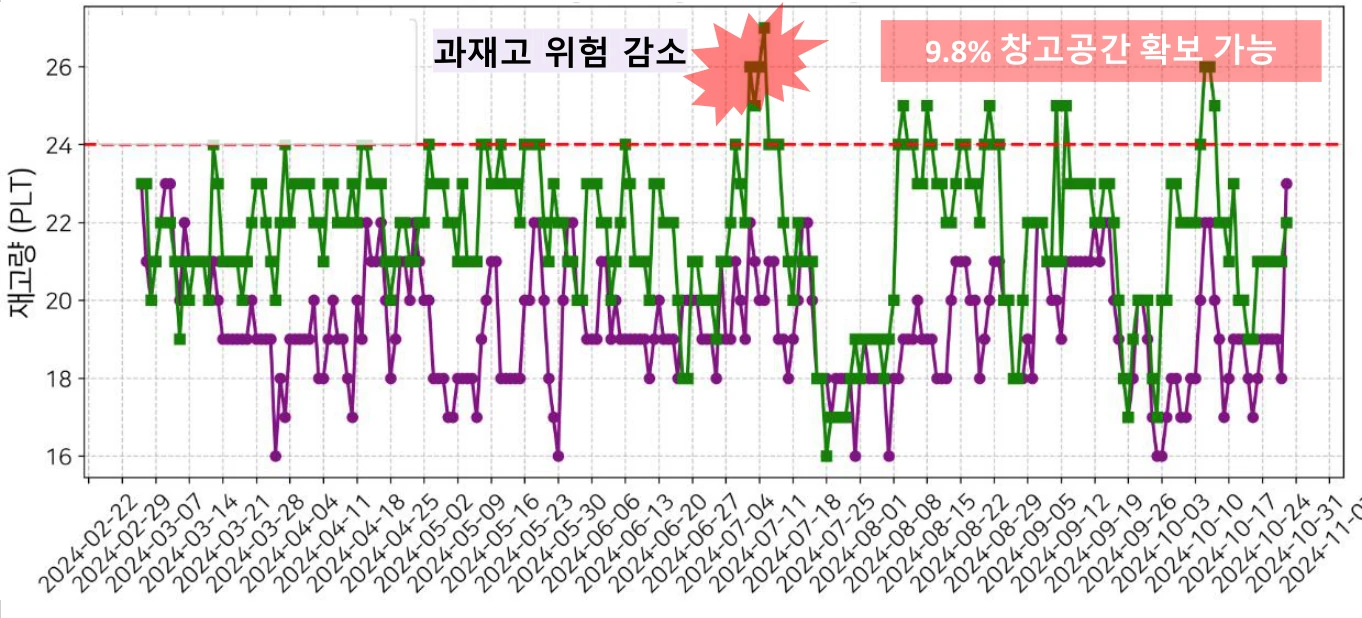
Reorder points and order quantities were evaluated together on historical stock flows, with warehouse space and demand coverage reviewed alongside stock levels.
- Industry
- Food distribution
- Decision family
- Inventory control
- Evaluation scope
- Inventory-policy simulation
Customer identity and identifying operational details are withheld.
The operating decision
Ordering too early or in large batches can fill the warehouse; ordering too late or too little can leave demand uncovered.
- Inputs
- On-hand stock · Inbound stock · Inbound and outbound history · Pallet quantities · Product ordering terms
- Decision
- Reorder point per item · Quantity per order
- Constraints
- Warehouse capacity · Demand coverage · Item pallet quantity · Ordering terms
How it is approached
Read the stock position
Combine inbound volume with stock on hand to determine when a product falls below its reorder point.
Adjust timing and quantity together
Vary the set point and order quantity under each product’s pallet and ordering conditions.
Replay the same demand
Compare candidate policies on the same stock-flow history, checking excess stock, occupied space and temporary stock-outs together.
See how an ordering policy changes the stock trajectory.
Stock check
on hand + inbound
Order decision
reorder point and quantity adjusted
Evaluated on past demand
stock, space and stock-outs checked
Inventory-policy simulation
Validation & scope
The source reports an optimization recalculation for a defined warehouse scope. Suppliers with missing data were excluded, and temporary stock-outs remained for some products. Further operational checking is needed before generalizing the space effect or treating it as realized savings.
Related decisions
All applications
Bring the decision, its data and its constraints.