
Water-treatment layout optimization
Review saved layout candidates with tank placement, equipment and pipe connections shown together.
- Industry
- Water treatment
- Decision family
- Spatial planning
- Evaluation scope
- Layout review
Customer identity and identifying operational details are withheld.
The operating decision
Tank and equipment placement determines which pipe connections fit within a site. Reviewing these decisions together helps a reviewer inspect the layout and its unresolved constraints before revising a design.
- Inputs
- Sample site boundary · Tank and equipment dimensions · Connection requirements · Spatial rules
- Decision
- Tank and equipment placement · Pipe paths · Layout candidate to review
- Constraints
- Site boundary · Non-overlap · Equipment access · Pipe connectivity
How it is approached
Describe the space and connections
Represent the site boundary, tanks, equipment and required connections as a spatial problem with explicit rules.
Inspect saved layout candidates
Compare embedded sample layouts in 2D and 3D. Separate tanks, equipment and pipes to inspect their placement and connections.
Review constraints and unresolved items
Read rule checks alongside the layout. Keep incomplete connections and failed checks visible when deciding which parts need revision.
A saved sample layout in three dimensions
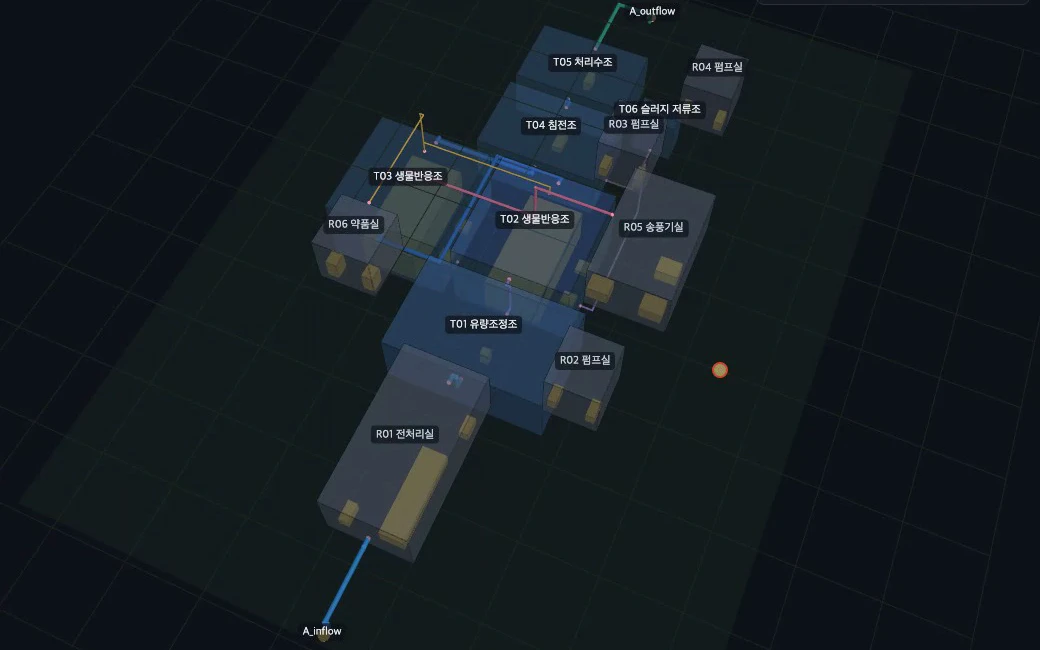
Layout review
Validation & scope
The review uses embedded sample problems and saved layouts. The image shows a sample scenario, not customer operating data. Saved layouts can include provisional placements and unresolved rule checks.
This material does not establish optimality, a finalized installation design, treatment performance or results achieved in operation. Process-control optimization is outside the scope of this example.
Related decisions
All applications
Bring the decision, its data and its constraints.