
Pipe route design
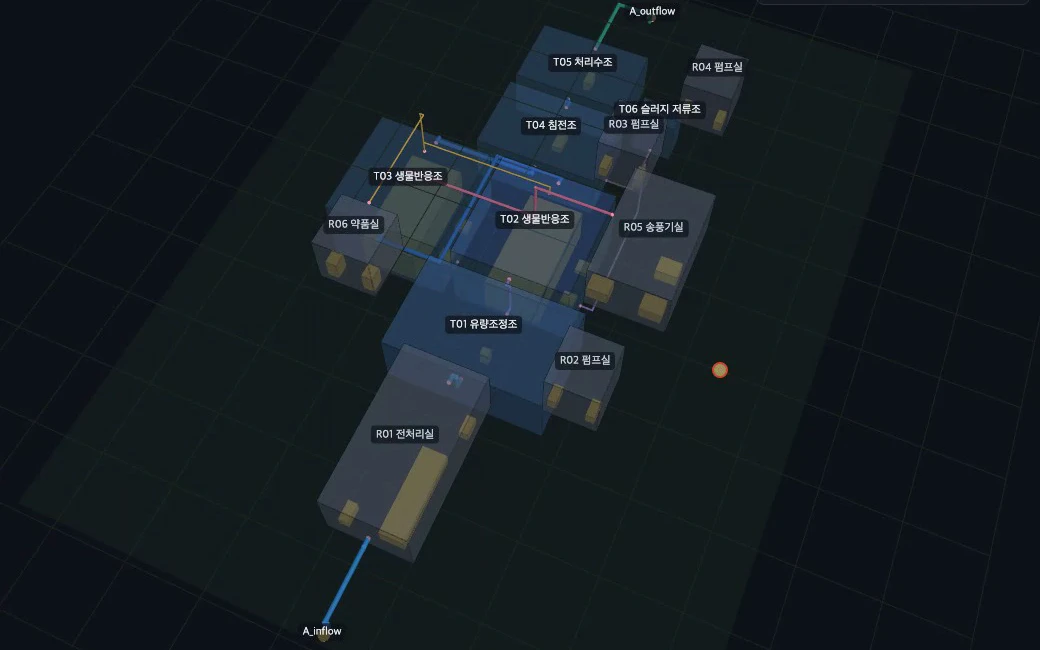
Tanks, equipment and pipe routes reconstructed from source drawings are reviewed together in 3D to inspect their connections.
- Industry
- Water treatment
- Decision family
- Sequence optimization
- Evaluation scope
- Drawing-based design review
Customer identity and identifying operational details are withheld.
The operating decision
Inspect how the original pipe design connects tanks and equipment, then review each system and viewing direction to identify details that need checking against the drawings.
- Inputs
- Source drawings · Tank and equipment outlines · Pipe systems and connections
- Decision
- Route and connection review · Pipe system to inspect · Viewing direction
- Constraints
- Drawing interpretation · Approximate equipment geometry · Existing design connections
How it is approached
Reconstruct the source design
Interpret tank outlines, equipment shapes and pipe routes from the drawings. The geometry remains an approximation for design review.
Inspect one pipe system at a time
Filter raw-water, treated-water, air, sludge, chemical and deodorization lines to inspect their routes and connections.
Compare views and visibility
Use angled, plan, front and side views, and toggle transparent structures, equipment and pipes to examine the reconstructed design.
Inspect pipe routes in the reconstructed design.
Drawing-based design review
Validation & scope
Equipment shapes and pipe routes are approximate interpretations of the source drawings. The material supports review of the original design; it does not establish optimized route performance, finalized construction dimensions or readiness for fabrication and installation.
Related decisions
All applications
Bring the decision, its data and its constraints.