
Nested-item packing
Nesting-compatible items were bundled before box selection, then evaluated with the remaining order items in candidate boxes.
- Industry
- Retail / Household goods
- Decision family
- Spatial planning
- Evaluation scope
- Packing experiment
Customer identity and identifying operational details are withheld.
The operating decision
Treating every item as a separate solid can waste the inner space of nestable shapes and force a larger box.
- Inputs
- Order contents · Item shape and inner dimensions · Nesting compatibility · Candidate box sizes
- Decision
- Nestable bundles · Placement of bundles and remaining items · Box selected per order
- Constraints
- Shape-specific nesting feasibility · Entire bundle contained in the box · Compatibility of remaining items
How it is approached
Identify compatible nesting
Check the inner height and shape of items that can nest, then form eligible bundles. Nesting is not assumed for every item.
Pack the changed item geometry
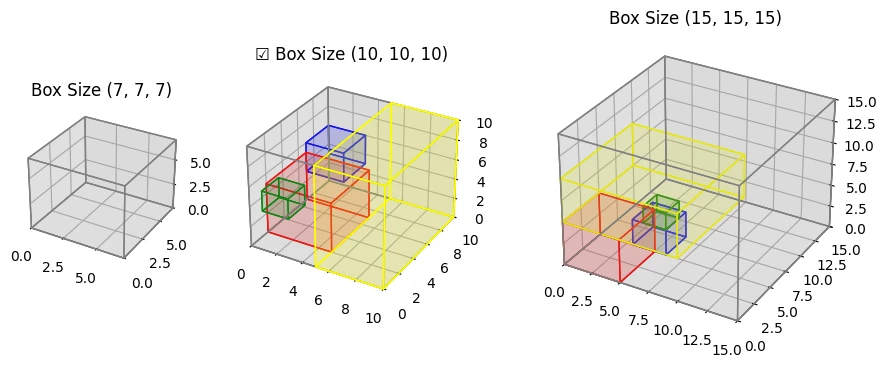
Evaluate each bundle together with the rest of the order, checking that the resulting arrangement fits entirely in the candidate box.
Compare against separate-item packing
Compare box choices, packaging area and calculation effort under matching order assumptions, keeping the illustrative example separate from the experiment.
Packing geometry, shown in the original experiment.
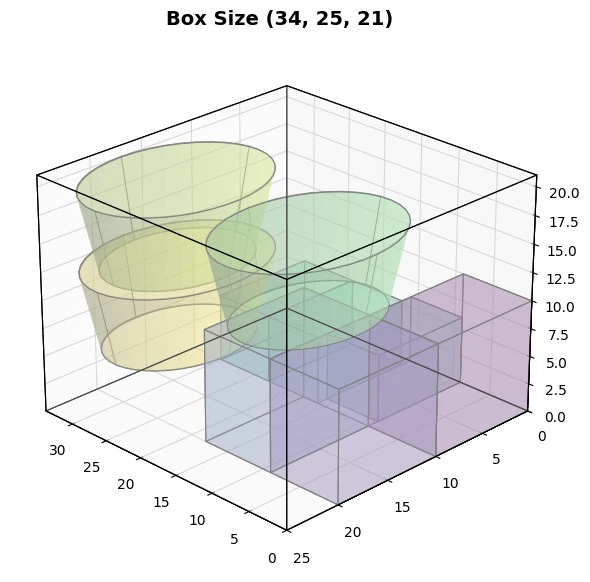
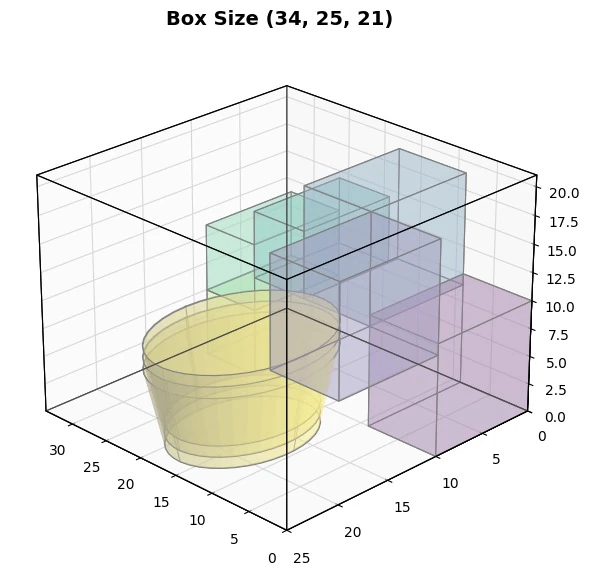
Packing experiment
Validation & scope
This was an assumption-based packing experiment comparing nesting with no nesting over a defined order set and candidate-box set. The illustration and aggregate comparison have different scopes; the result does not establish realized material or operating savings.
Related decisions
All applications
Bring the decision, its data and its constraints.