
Delivery-zone redesign
Vehicle routes and delivery-zone assignments were compared in separate scenarios, including redistribution after a distribution-center consolidation.
- Industry
- Retail distribution
- Decision family
- Sequence optimization
- Evaluation scope
- Operating-data scenarios
Customer identity and identifying operational details are withheld.
The operating decision
Keeping existing store assignments can limit route improvements, while changing the network also changes each center’s workload and vehicle needs.
- Inputs
- Store order volumes · Existing center assignments · Delivery windows · Vehicle capacities · Driving conditions · Cost assumptions
- Decision
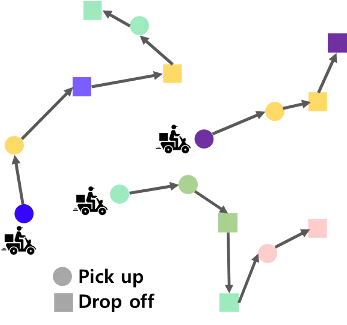
- Vehicle-to-store assignment · Visit order · Center-to-store assignment under redistribution scenarios
- Constraints
- Center operating hours · Fixed delivery windows · Vehicle access · Load capacity · Multi-trip runs
How it is approached
Improve routes within the current network
Keep center-to-store assignments fixed while adjusting vehicles and visit order under actual operating conditions.
Compare redistribution choices
Examine a partial redistribution of affected stores and a wider redesign across service zones as separate scenarios.
Use a common cost basis
Evaluate fixed vehicle cost, fuel and extra trips together, preserving the baseline and scope of each scenario comparison.
From a new route to a different service network.
Operating-data scenarios
Validation & scope
These are potential cost differences from scenario analysis on operating data, not savings realized after deployment. Maps and cost analysis came from separate presentation materials and were not confirmed as the same run. Sequential scenario differences must not be added together.
Related decisions
All applications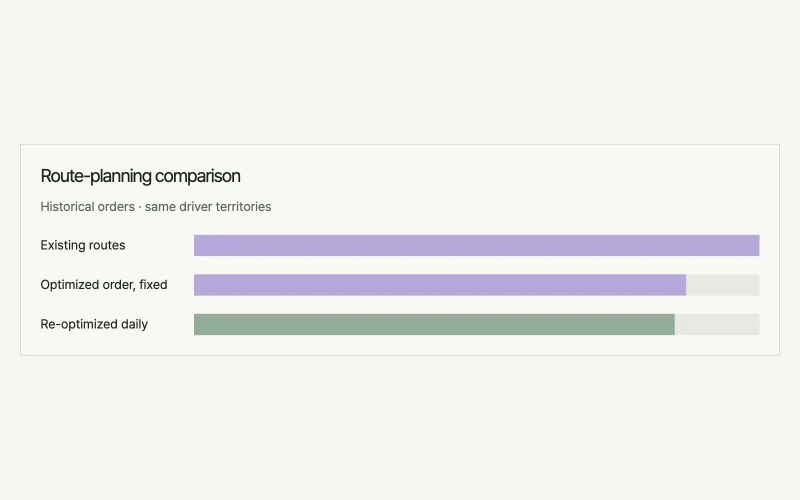
Bring the decision, its data and its constraints.