
Hub service and transport routes
Transport routes were compared with the services available at transit hubs, so a low freight quote could be evaluated against the complete handling path.
- Industry
- Automotive logistics
- Decision family
- Sequence optimization
- Evaluation scope
- Early route-cost analysis
Customer identity and identifying operational details are withheld.
The operating decision
The cheapest transport leg may be unsuitable if the required service is unavailable at its hub or if handling charges outweigh the freight difference.
- Inputs
- Vehicle types · Origins and destinations · Required services · Transport history · Contract rates · Hub handling costs
- Decision
- Transit hubs · Service assignment · Connecting transport legs
- Constraints
- Required hub services · Connected inbound and outbound transport · Feasible origin-to-destination paths
How it is approached
Link cargo to its service needs
Associate each vehicle type and origin–destination pair with the services that must be completed along the way.
Build feasible hub paths
Keep route candidates only when the chosen hubs can provide those services and the surrounding transport legs connect.
Review the complete cost
Add handling and unloading costs to freight when comparing feasible paths, while distinguishing early freight-only findings from the full logistics decision.
The decision structure
Early route-cost analysis
Validation & scope
The source presents an early route-choice analysis. Its illustrative path and full-analysis results have different scopes, and freight comparisons do not establish realized savings or total logistics-cost outcomes.
Related decisions
All applications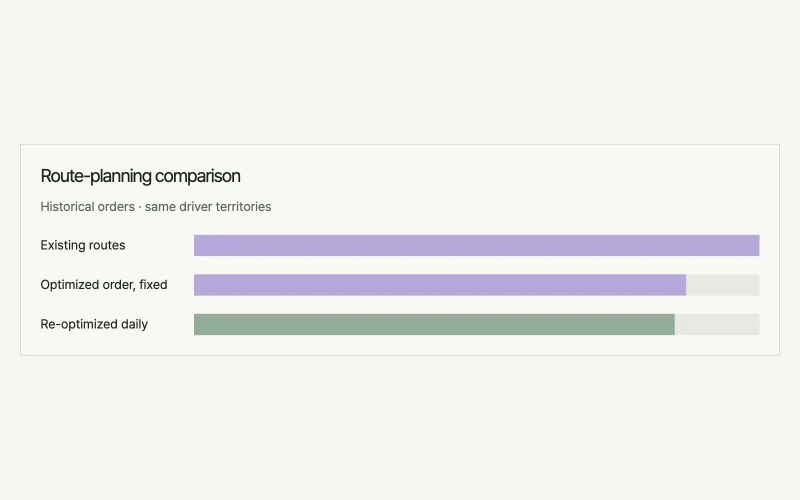
Bring the decision, its data and its constraints.