
Multi-trip distribution
Orders, vehicle trips and visit sequences were reviewed together to use contracted capacity before comparing extra vehicles for uncovered demand.
- Industry
- Logistics / Distribution
- Decision family
- Sequence optimization
- Evaluation scope
- Decision and input review
Customer identity and identifying operational details are withheld.
The operating decision
Planning stops in sequence can leave trips unbalanced, contracted capacity underused and extra vehicles necessary.
- Inputs
- Delivery orders · Contracted-vehicle terms · Vehicle types · Delivery zones · Delivery windows
- Decision
- Order-to-vehicle assignment · Trip composition · Visit order · Extra-vehicle use
- Constraints
- Load capacity · Distance per trip · Delivery windows · Primary and secondary service zones
How it is approached
Allocate orders across trips
Decide which vehicle serves which stops on each trip, applying the contracted operating terms.
Check the complete trip
Evaluate the proposed visit order against capacity, distance, time and zone restrictions before treating a trip as feasible.
Review coverage and extra vehicles
Read order coverage, vehicle load and extra-vehicle cost together, and identify input conditions that prevent a workable plan.
One fleet. Several trips. One connected plan.
Decision and input review
Validation & scope
The source describes input review and the decision structure. Capacity violations, distant stops and zone mismatches were identified in the data; improvement over the existing dispatch was not yet measured. The dispatch figure is illustrative.
Related decisions
All applications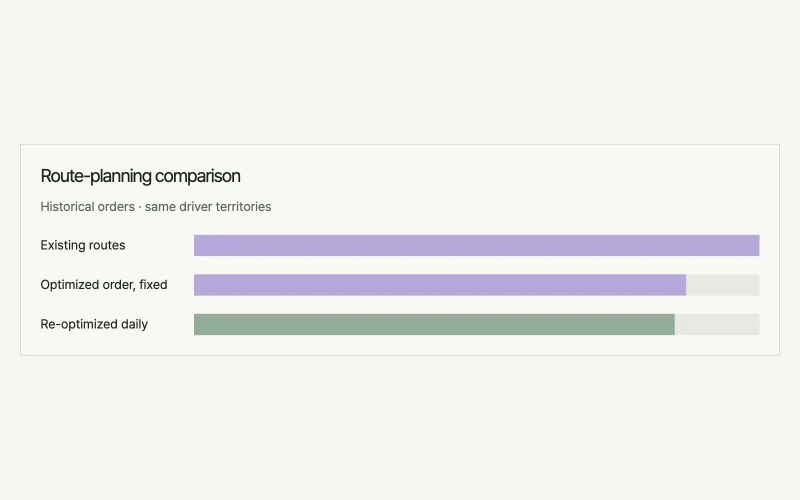
Bring the decision, its data and its constraints.