
Collection and unloading routes
Collection routes were modeled with plant visits, weighing, unloading and restart, so vehicle load and work time could be reviewed over complete runs.
- Industry
- Resource collection
- Decision family
- Sequence optimization
- Evaluation scope
- Run reproduction study
Customer identity and identifying operational details are withheld.
The operating decision
Nearby pickups can still create a long or overloaded run once collection work, plant visits, weighing and unloading are included.
- Inputs
- Pickup locations · Collection workload · Vehicle capacity · Plant and weighing locations · Measured course and work times · Navigation travel times
- Decision
- Pickup assignment · Visit order · Plant visits · Unloading and restart points
- Constraints
- Vehicle load limit · Working time · Required weighing and unloading sequence
How it is approached
Model a complete collection cycle
Represent collection, weighing, unloading and the next trip as one sequence instead of treating unloading as an afterthought.
Check load and working time
Evaluate each pickup run with its plant visits, vehicle capacity and service work included.
Validate the timing model first
Replay measured courses while fixing visit order, departure and work time, and recalculate travel time from navigation sources to inspect timing error.
Check that the model reproduces the run.
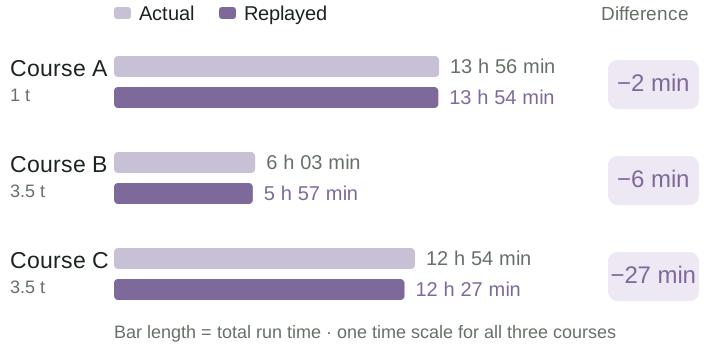
Run reproduction study
Validation & scope
The validation examines reproduction of measured run times, not time or cost savings from optimized routes. Unexplained return legs were excluded, and per-leg checks are necessary because errors can cancel in a total. The delivered demonstration and timing evidence have distinct scopes.
Related decisions
All applications
Bring the decision, its data and its constraints.