
Seasonal delivery planning
Baseline delivery routes and daily overflow vehicles were compared across seasonal volume assumptions while retaining delivery conditions.
- Industry
- Retail distribution
- Decision family
- Sequence optimization
- Evaluation scope
- Seasonal scenario evaluation
Customer identity and identifying operational details are withheld.
The operating decision
A route that works at ordinary volume can exceed vehicle capacity during peak demand, increasing extra-vehicle use while delivery promises still apply.
- Inputs
- Seasonal volume scenarios · Daily cutoff orders · Store locations · Vehicle capacity · Delivery windows · Contracted and extra-vehicle cost assumptions
- Decision
- Base-route volume assumption · Vehicle mix · Store assignment · Visit order · Daily overflow routes
- Constraints
- Vehicle load limit · Existing delivery windows · Feasible daily routes · Scope of any window renegotiation
How it is approached
Compare baseline route designs
Evaluate partial route changes and a complete redesign under different seasonal volume assumptions.
Apply daily demand to the base plan
Check the load created by cutoff orders and assign overflow stores to separate delivery routes when capacity is exceeded.
Review the year-round trade-off
Compare contracted and extra-vehicle costs across the seasonal scenarios, then assess whether selected delivery-window changes merit discussion.
Plan for seasonal volume and the operating changes it needs.
First, choose the volume baseline
With delivery windows unchanged, off-peak, average and peak designs are compared.
Extra vehicles included
When summer volume exceeds the load limit, separate vehicles are needed. Contracted and extra vehicles are costed together.
Delivery-window renegotiation, selectively
The cost gained from wider windows and the number of stores to renegotiate decide the scope of change.
Seasonal scenario evaluation
Validation & scope
The reported differences are between design scenarios, not realized savings against the current operation. Partial and full redesigns are separate alternatives. Fuel and transition costs were excluded from the source comparison, and operational validation is still needed before use. The demonstration is a mock-up separate from that evaluation.
Related decisions
All applications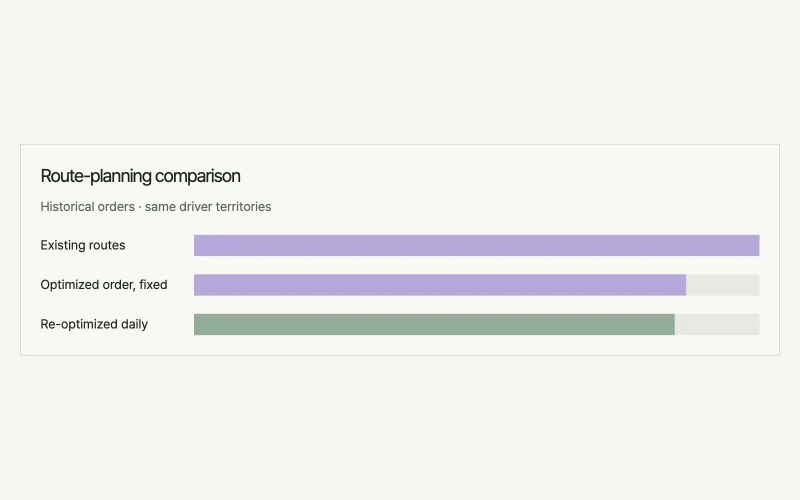
Bring the decision, its data and its constraints.