
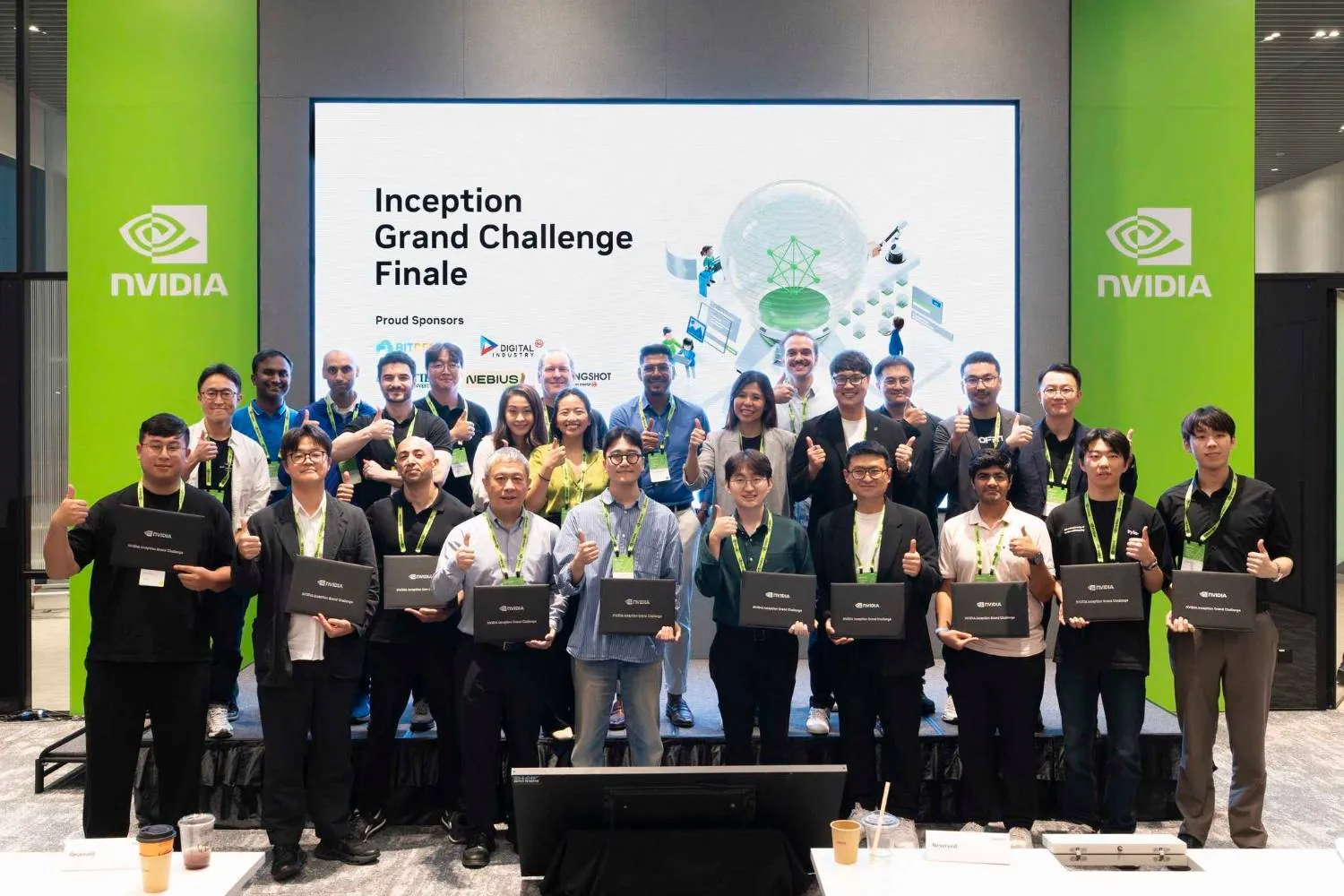
Omelet (Jinkyoo Park, CEO), an optimization AI company, has been selected as one of the Top 10 companies of the NVIDIA Inception Grand Challenge 2026 in the Asia-Pacific region.
The NVIDIA Inception Grand Challenge supports growth-stage AI startups in the Asia-Pacific region in applying their technology to real industrial problems and expanding their business with enterprise customers.
Omelet passed a multi-stage evaluation that narrowed the field from 150 companies to 80, 40, 20, and finally 10. After the Korea semifinal on August 27, Omelet advanced to the Asia-Pacific final held on September 22 at Guoco Midtown Network Hub in Singapore, where the Top 10 were announced. The Top 10 companies will have the opportunity to showcase their technology on the global stage and to pursue technology validation and business collaboration with NVIDIA and enterprise partners.
Operational Intelligence built into the core decisions of industry
At the final, Omelet presented Operational Intelligence, the direction the company is pursuing. Omelet's vision is to build Operational Intelligence into the core operational decisions of complex industrial systems.
Industrial operations repeat decisions that must account for countless constraints and changes, such as dispatching and routing in logistics, staff schedules in hospitals, and task assignment for robots. Omelet defines Operational Intelligence as the ability to compute these decisions well, connect them to real operations, and learn from the results to improve the next decision, a cycle of Decide, Operate, Learn, and Decide Better.
Omelet solves complex operational problems in industry and accumulates the problem-solving capabilities gained in the process as reusable assets. Recurring decision structures and computation methods, field workflows, and a common operating foundation for enterprise environments become the basis for solving the next customer's problem. To build these assets and connect them to customer operations, Omelet is developing three product and work platforms.
- OI Factory defines, solves, validates, and generalizes new customer problems, turning them into reusable problem-solving capabilities.
- OI Studio is a workspace for exploring, composing, running, and comparing accumulated decision capabilities through natural language and AI agents.
- OI Foundry is a production platform that combines validated decision capabilities, domain-specific software assets, and a common operating platform to fit each customer's data and requirements, and builds, validates, and deploys operational applications.
The aim is a structure in which common assets and problem-solving capabilities grow stronger with every project, reducing the time and cost of building the next customer's application. Feedback and learning from operations flow back into improving these assets and products.
Optimization AI proven in paid production
Omelet develops AI solutions that optimize complex operational decisions across routing, packaging, scheduling, and inventory control. Omelet is currently running 18 projects with 15 enterprise customers across seven industries, including logistics, retail, healthcare, manufacturing, mobility, defense, and entertainment. GS Retail uses Omelet's technology for delivery routing and Hyundai Glovis for ship stowage, both in paid production. Deployments have cut logistics costs by more than 20% and raised ship stowage efficiency to over 90%.
"This Top 10 selection is a meaningful milestone in introducing our direction on the global stage," said Jinkyoo Park, CEO of Omelet. "We are grateful to NVIDIA, the judges, the startup teams from each country, and the customers and partners who solve problems with Omelet in the field. We will turn the problem-solving capabilities gained from projects into assets, develop those assets into products that more customers can use, and connect industrial decisions to real operations faster and better."